
That Sharp Pain On The Outside Of Your Knee Is Not Arthritis. Meet The Real Culprit (It Is Not Your Joint)


You did everything right.
You rested it. You iced it after every walk. You bought the knee sleeve from the pharmacy, then the better one from the internet.
You paid the copays.
You had the X-ray that showed "a little wear, normal for your age". You took the glucosamine. You changed your shoes. You did the quad exercises the physical therapist printed out for you.
And every time you tried a longer walk, or a flight of stairs going down, the same thing happened.
A sharp, stabbing pain on the outside of the knee. Right on the bony bump. Worse with every step until you had to stop.
That is not a failure of effort.
That is a failure of diagnosis.
Because the thing stabbing the outside of your knee has, in most cases, never once been your knee joint.
It has a name. Runners have known about it since 1975. It does not show up on your X-ray because it is not bone, and it hides on an MRI because nobody is looking for it.
And in 24 years as a physical therapist, I watched it get treated as arthritis almost every single time.
I'll show you exactly what it is in a moment.
But first, there is something you need to stop doing.
STOP ICING THE KNEE

If anyone has told you to ice the knee, rest the knee, wrap the knee, or buy a sleeve that squeezes the knee, I want you to do one thing before you read any further.
Stop.
Not because ice is bad. Because it is in the wrong place.
The pain you feel is at the outside of the knee. But the thing causing it sits one to two inches above it, on the outside of the thigh. Every ice pack, every sleeve and every brace you have ever bought went on the joint. The problem was never on the joint.
Worse, the rest makes it tighter. The sleeve squeezes the wrong tissue. And the stretching routine on YouTube cannot lengthen the thing that is actually causing the pain, because that tissue does not lengthen. Studies that measured it found less than a millimetre of change.
Your body has been giving you the clue the whole time: it hurts going downhill and down stairs, and it eases when the leg is straight or fully bent. That pattern has exactly one explanation.
Nobody told you what it was.
That changes right now.

My name is Karen Whitfield, DPT. I have been a physical therapist for 24 years. I have treated thousands of knees. And at 56, on the second day of a hiking trip, I got this exact pain myself and nearly made the same mistake everyone makes.
THE AFTERNOON EVERYTHING CHANGED
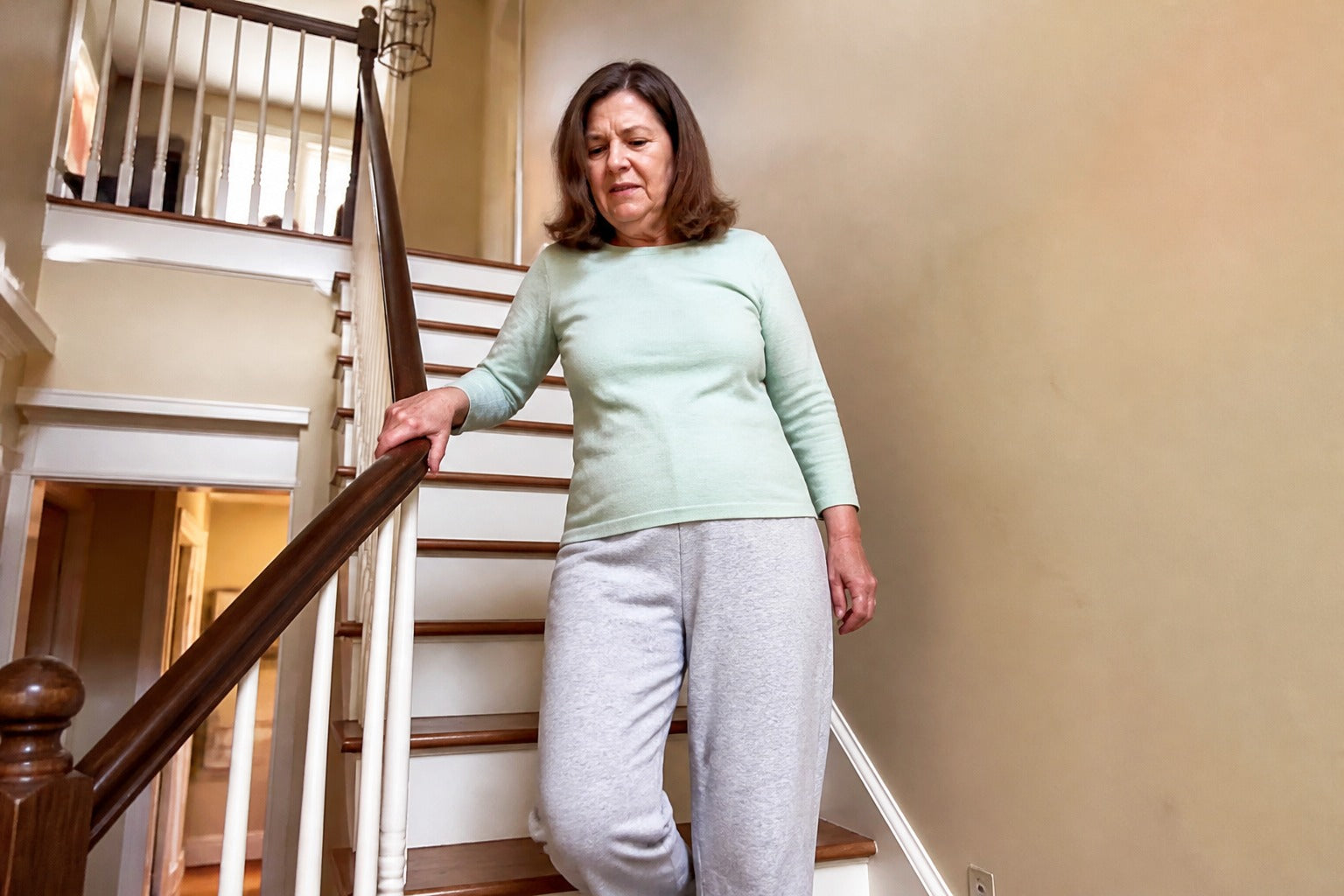
It was the second day of a walking holiday in the Smoky Mountains. My husband and I had been planning it for a year.
The climb was fine. It was the way down that got me.
About twenty minutes into the descent, a sharp pain started on the outside of my right knee. Not an ache. A stab. Every time my knee bent past a certain point on the way down, it fired.
By the bottom I was walking sideways down the trail like a crab, one step at a time, holding my husband's arm.
Here's what embarrassed me most.
I had spent 24 years telling people what was wrong with their knees. And standing on that trail, I did exactly what my patients do. I decided it was the joint. "I'm 56. It's probably the start of arthritis. I'll rest it."
I rested it for three weeks. I iced it. I wore a sleeve. I booked an orthopedic appointment.
The X-ray was clean. The MRI showed "mild age-related changes", which is radiology for nothing to see here. The orthopedist, a man I respect, said: "You're 56. Some of this is just the mileage."
Then I went for a walk around the block and it stabbed me on the first downhill driveway.
That night, something inside me snapped.
Because the joint was fine. The imaging said so. So the pain was coming from something that imaging does not look at.
THE DISCOVERY I SHOULD HAVE MADE TWENTY YEARS EARLIER

The next morning I sat on the edge of my bed and pressed my thumb into the outside of my thigh, about two finger-widths above the kneecap.
I nearly hit the ceiling.
Not the knee. Not the joint line. Above it. A spot so tender I could not believe I had walked past it for three weeks.
And then it all came back. A 1975 paper on Marine recruits. The runners I treated in my twenties. A condition that sports clinics see every week and that family doctors almost never think of in a 60-year-old woman who does not run.
The iliotibial band.
The IT band. A thick strip of connective tissue that runs from the outside of your hip, down the outside of your thigh, and anchors just below the outside of your knee.
It is not a muscle. It does not stretch. And when it is tight, it does something to the outside of the knee that no X-ray will ever show you.
Let me explain what is actually happening.
THE REAL REASON THE OUTSIDE OF YOUR KNEE HURTS
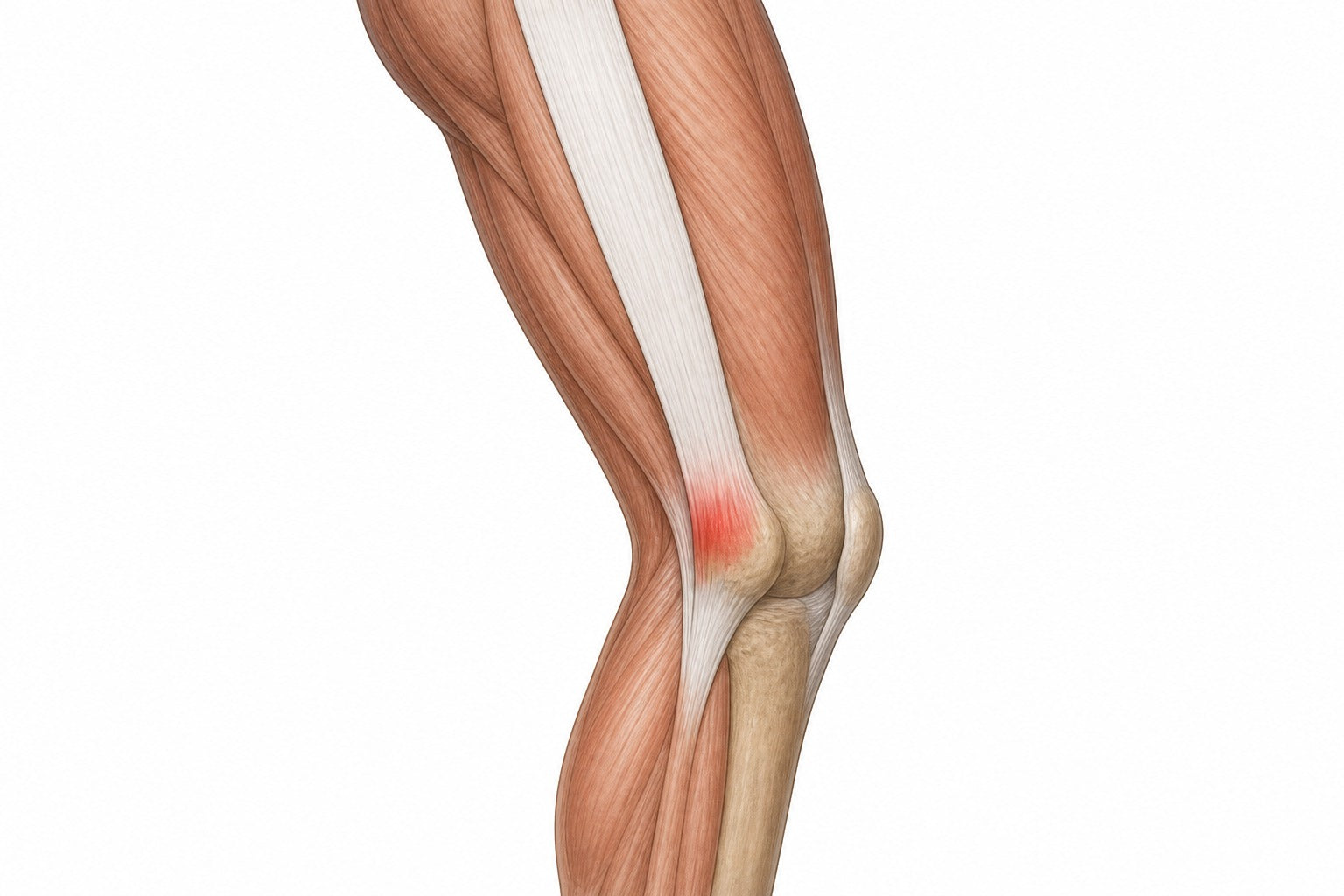
On the outside of your knee there is a bony bump. You can feel it right now: the hard knob on the outer side, just above the joint line. Doctors call it the lateral epicondyle.
The IT band runs straight over the top of it.
When your leg is straight, the band sits in front of the bump. When your knee is fully bent, the band sits behind it. And at roughly 30 degrees of bend, the band crosses the bump.
Every. Single. Step.
Walking on the flat, you pass through 30 degrees quickly and the band glides across. But walking downhill, or down stairs, or standing up from a low chair, your knee is loaded right at that angle. The band is pulled tight across the bump at the exact moment your body weight is on it.
Tight band. Bony bump. Full body weight. A thousand times per mile.
The tissue trapped in between, a small cushion of fat and a fluid sac, gets squeezed and rubbed until it is swollen and raw.
I call this The Friction Zone.
And it is why your pain is so specific. It is a stab, not an ache. It is on the outside, not inside the joint. It comes on after a certain distance, not straight away. It is worst going down. It eases when you straighten the leg. None of those things describe arthritis. All of them describe a band rubbing over a bump.
And here is why every scan came back "normal".
The joint is normal. The cartilage is fine. The rubbing happens on the outside of the bone, in tissue so thin that an MRI reads it as a shadow unless the radiologist is told to look for it.
So you got told it was your age.
WHY IT SHOWS UP AFTER 50

Runners get this at 25 from mileage. So why does it arrive at 55 or 60 in someone who has never run a step?
Because of the hip.
The IT band is held at its correct tension by a muscle on the side of your hip. That muscle's job is to keep your pelvis level every time you stand on one leg, which is what walking is: standing on one leg, then the other, several thousand times a day.
After 50, and for women especially after menopause, that hip muscle loses strength faster than almost any other muscle in the body. When it weakens, the opposite side of the pelvis drops a fraction with every step.
A dropping pelvis pulls the IT band tighter on the standing leg. Tighter band, harder rub, sooner pain.
Here is what nobody explained to me, and I am the one who should have known.
That is why the usual advice fails:
- Rest lets the band stiffen and the hip weaken further. You come back and it hurts sooner than before.
- Ice and sleeves work on the joint. The joint was never the problem.
- Stretching cannot lengthen the band. It is built not to stretch; that is its job.
Nothing on that list touches the bump, the band, or the angle at which they meet.
More room over the bump. Less tension on the band. That is the whole task.
THE TWO-INCH FIX HIDING IN PLAIN SIGHT
Remember me, crab-walking down that trail?
Two weeks after I found the tender spot, I walked the same loop around my neighbourhood, downhill driveways and all. Then I walked it again the next day.
I did not stretch more. I did not rest more. I did not have an injection.
I did something sports clinics have done for runners for forty years, and nobody had thought to offer a 56-year-old woman.
I put counter-pressure on the band, one to two inches above the knee.
Firm pressure against the outside of the thigh at that spot does two things at once. It changes the angle the band takes as it approaches the bump, so it no longer snaps across the edge under load. And it spreads the band's tension over a wider area, so the one point that was taking all the force stops taking all the force.
To actually take the friction off the bump, the pressure has to do THREE things:
SIT IN THE RIGHT SPOT: above the knee on the outside of the thigh, not on the joint. An inch too low and you are back to squeezing the knee.
STAY PUT: on a thigh, walking, for an hour. A thin elastic band migrates down to the knee within ten minutes.
PRESS WITHOUT STRANGLING: firm against the band, without cutting off circulation or leaving a welt.
Miss any ONE of those and you are wasting your time.
That is why a knee sleeve does nothing here. (Wrong spot.)
That is why a strip of tape does not last. (Will not stay.)
That is why wrapping a bandage round your thigh is a bad idea. (Strangles the whole leg to press one inch of it.)
You need firm pressure, held exactly there, by something that does not move.
That is exactly what we built.
INTRODUCING THE VELLSTRIDE LATERAL KNEE STRAP

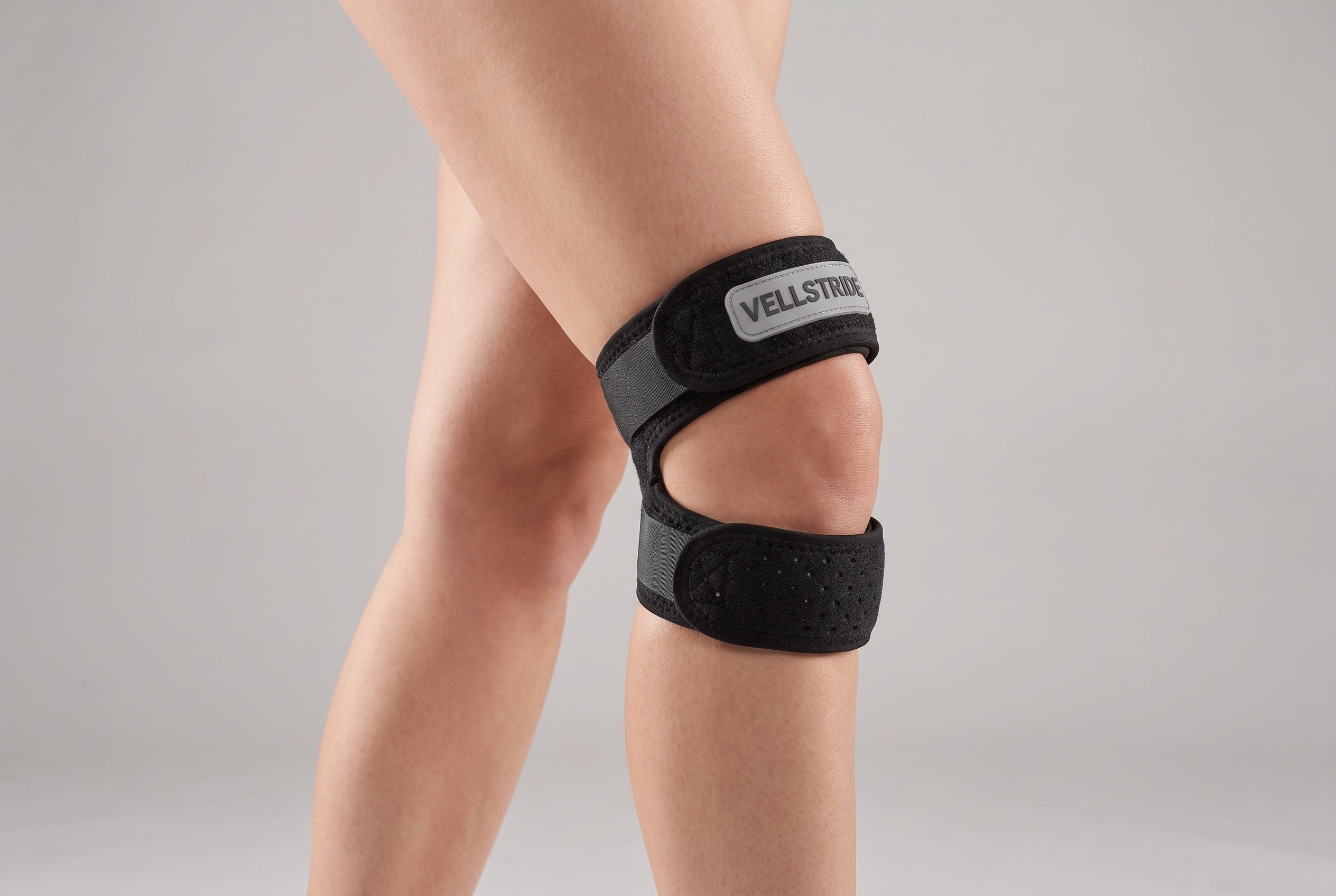
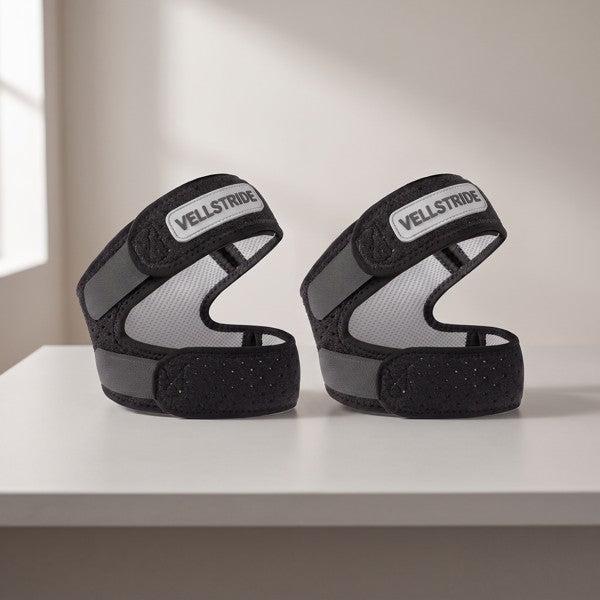
The Vellstride Lateral Knee Strap is a double-band strap of breathable perforated neoprene with a mesh lining. The upper band does the work. The lower band keeps it there.
✓ UPPER PRESSURE BAND: sits against the band of tissue on the outside of the thigh, just above the kneecap, and spreads its tension across the width of the strap, instead of letting it concentrate on the bump.
✓ LOWER ANCHOR BAND: fastens below the kneecap so the upper band cannot slide down. Both bands adjust with hook-and-loop to fit a leg 16.5 to 19 inches around just above the knee, and stay where you put them on a two-hour walk.
✓ BREATHABLE, UNDER CLOTHES: thin enough to wear under trousers or leggings. Nobody at church knows it is there.
✓ ONE SIZE, EITHER LEG: it fits left or right. And every order comes as a pair, for a reason I will explain in a moment.
You fasten the upper band just above the kneecap, firm against the outside of your thigh, fasten the lower band below the kneecap, and walk.
No appointments.
No copays.
No injection into a joint that was never the problem.
No waiting three weeks to find out.
WHAT HAPPENS ON YOUR FIRST WALK
When you fasten the strap and take your first steps, here is what people describe.
The first hundred yards: the stab changes. For many people the sharp catch on the outside of the knee is dulled or gone on the very first downhill, because the band is no longer snapping over the bump. That is mechanics, not magic: the pressure changes the angle, and the angle was the problem.
The first week: the distance comes back. Walks that used to stop at the corner reach the end of the street, then the park. Stairs stop being something you plan around.
The first month: the tissue settles. Every day the band is kept off the bump is a day the swollen tissue underneath is not being rubbed raw. Given that chance, it calms down on its own.
After that? Most people keep the strap for the long walks, the hills and the days on their feet, and forget about it the rest of the time.
Individual experience varies, and the people below are describing theirs.
WHAT PEOPLE ARE SAYING


"I'm 64. Two years of 'it's arthritis', a cortisone shot that did nothing, and a knee sleeve in every drawer. I put this on two inches above the knee like the article said and walked down my own driveway without the stab for the first time since 2024. I cried in the garage."
"Retired teacher, 68. Stairs were the enemy. I wear it under my trousers on walking days and nobody can tell. The second strap went to my sister, who had the exact same pain and the exact same 'normal' X-ray."
"61, I walk the dog three miles a day or I go stir crazy. Was down to one mile. The explanation about the bump made more sense than anything my doctor told me. Back to three miles, strap on for the hilly bit."
"I was quoted an arthroscopy. I asked for one more month and bought these instead. I still have my month, and my knee, and I cancelled the surgery consult. Make of that what you will."
WHAT IT COSTS TO KEEP GUESSING

Let me show you what treating the wrong thing costs, because I have watched patients spend it.
The Physical Therapy Route:
- 2x a week for 8 weeks = 16 visits
- $150 to $200 a visit after insurance
- Total: $2,400 to $3,200, mostly quad exercises for a quad that was fine
The Injection Route:
- Cortisone into the knee joint: $300 to $800 each
- Into a joint that, in this case, is not the problem
- Repeated every few months while the band keeps rubbing
The Imaging-and-Surgery Route:
- MRI: $1,200 to $3,000
- Knee arthroscopy "to have a look": $5,000 to $20,000
- Six weeks of recovery, for a procedure that happens inside a joint the band rubs outside of
I am not telling you these are bad doctors. I am telling you they are treating the knee, and the knee was never the problem.
A pair of straps that sit on the actual problem costs less than one copay.
The regular price for the pair is $120.
But that is not what you will pay today.
WHY WE SEND TWO, AND CHARGE FOR ONE
When I started handing these to patients, two things happened over and over.
First, the pain moved. Someone with a right-knee problem limped for a year, overloaded the left hip, and the left band started rubbing. They came back for a second strap.
Second, they gave it away. A sister, a husband, the neighbour with the "arthritis" that behaved exactly like theirs.
So every order on this page is a pair. Buy one, and the second strap is free.
Today that is $60 for two. $30 a strap. Less than the parking at the orthopedic clinic.
- Less than ONE physical therapy copay.
- Less than a tenth of one cortisone injection.
- Less than the knee sleeve you already bought that went on the wrong spot.
For the one thing that actually sits on the problem.
LOOK, I UNDERSTAND THE SKEPTICISM
You have been down this road. You have a drawer of things that were supposed to help. You have been told "it's your age" by people with diplomas on the wall.
So here is my promise, and it is the only promise on this page:
Wear it for 90 days. If you are not glad you bought it, email us and we refund every penny.
- No forms.
- No "store credit".
- No questions you do not want to answer.
You keep the straps. Give them to someone with a bony bump of their own.
Why am I comfortable making that offer? Because the mechanics are not in dispute. The band crosses the bump at 30 degrees. Pressure above the knee changes the angle. Sports clinics have relied on it for decades. All I did was stop assuming a 60-year-old walker needed something different from a 25-year-old runner.
Support: support@vellstride.com
BUT HERE'S THE CATCH
The buy-one-get-one pricing on this page is for readers of this article, and we review it every week based on stock.
Our current batch is 2,000 pairs. We make them in small runs because every strap is stitched and checked by hand, and that is the slow part.
We do not sell on Amazon. Everything there with our name on it is a copy: a single elastic band with nothing to hold it in place, and a band that slides does not do the job described above.
If you are reading this, the pair pricing is still available.
I cannot promise it will be tomorrow.
And here is the thing...
Every walk you wait is another walk you:
- Rub the same raw tissue over the same bump
- Let the hip weaken a little more from the limp
- Plan your life around a flight of stairs
While the thing that sits on the actual problem costs $60 and arrives in a few days.
THE CHOICE THAT DECIDES YOUR NEXT TEN YEARS OF WALKING
Right now, you are at a fork.
Path #1: Keep Treating The Knee
Keep icing the joint, resting the joint, sleeving the joint. Keep hearing "it's your age". Keep shortening the walks until there are no walks.
Path #2: Put Pressure On The Actual Problem
Spend less than a copay on a pair of straps, put them on the way this article describes, and find out on your own driveway whether the article you just read was right.
The choice seems pretty obvious to me.
HERE'S EXACTLY WHAT TO DO NEXT
- 1. Click the button below that says "Check Availability Now →"
- 2. Choose your pack. (Most people take the pair. If someone in your house has the same "arthritis", take two pairs.)
- 3. Fill in your shipping details. Orders ship from our US warehouse within one business day.
- 4. When it arrives, find the bony bump on the outside of your knee, go up two finger-widths, and fasten the upper band there.
- 5. Walk down your driveway. Then email us and tell us what happened. We read every one.
But whatever you do, don't close this page thinking "I'll order later."
Later is another shortened walk.
Later is another flight of stairs taken sideways.
Later is the pair pricing being reviewed.
Your knee has been telling you where the problem is for long enough. Two inches up.
Click below and put something on it.
READER OFFER
FOR A LIMITED TIME:
BUY ONE, GET ONE FREE + FREE US SHIPPING
LIMITED TIME READER-ONLY SPECIAL:
Ordering from this page gets you the pair for $60, free US shipping, and the 90-day money-back promise above.
With respect, and a strap on my own right leg,
Karen Whitfield, DPT
Physical Therapist, Vellstride
P.S. I just got back from the Smoky Mountains. Same trail. Same descent. I walked it facing forwards.
P.P.S. If you have been told "it's arthritis" and your pain is a stab on the outside of the knee that is worst going down, press your thumb two finger-widths above the kneecap on the outside of your thigh. If that spot is tender, you already know what you have.
P.P.P.S. The pair pricing is reviewed weekly against stock. The button below is the only place it exists.